

Traditional surveying relied heavily on theodolites, total stations, and manual documentation—methods that delivered reliable results but demanded significant time and labor. A single commercial property survey might require multiple site visits, with teams spending days collecting measurements that would later be compiled into floor plans and reports. The margin for human error remained a persistent concern, particularly in complex environments with irregular geometries or hard-to-reach spaces.
The introduction of 3D cameras for virtual tours fundamentally altered this workflow. Rather than capturing individual measurements point by point, surveyors could now document entire environments in comprehensive three-dimensional detail during a single scan session. This shift responded directly to growing market demand—clients increasingly expected interactive virtual tours alongside traditional deliverables, and they expected those tours to reflect accurate spatial relationships.
What makes this evolution particularly significant for surveyors is the convergence of visualization and measurement. A 3D LiDAR scanner embedded within a camera system doesn’t merely produce attractive imagery; it generates dense spatial datasets that support dimensional analysis. Paired with a high-resolution camera capable of capturing photographic detail at extraordinary fidelity, these systems produce outputs that serve dual purposes: immersive visual experiences and measurement-grade documentation. The surveying profession now operates at the intersection of precision engineering and digital media, and the tools have evolved to meet both demands simultaneously. This convergence represents not just a technological upgrade but a fundamental rethinking of what surveying deliverables can accomplish.
Core Components of 3D Cameras for Precision Surveying
3D LiDAR Scanner: Capturing Detailed Spatial Data
At the heart of modern surveying-grade 3D cameras lies the 3D LiDAR scanner, which emits thousands of laser pulses per second to map surfaces with millimeter-level precision. Each pulse returns as a data point, and collectively these points form a dense point cloud—a three-dimensional representation of the scanned environment containing millions of individually measured coordinates. For surveyors, this means capturing complex geometries, structural details, and spatial relationships that manual methods might miss or approximate. The resulting point cloud data serves as the mathematical foundation upon which accurate virtual tours are built, ensuring that every wall angle, ceiling height, and room dimension reflects ground truth rather than estimation.
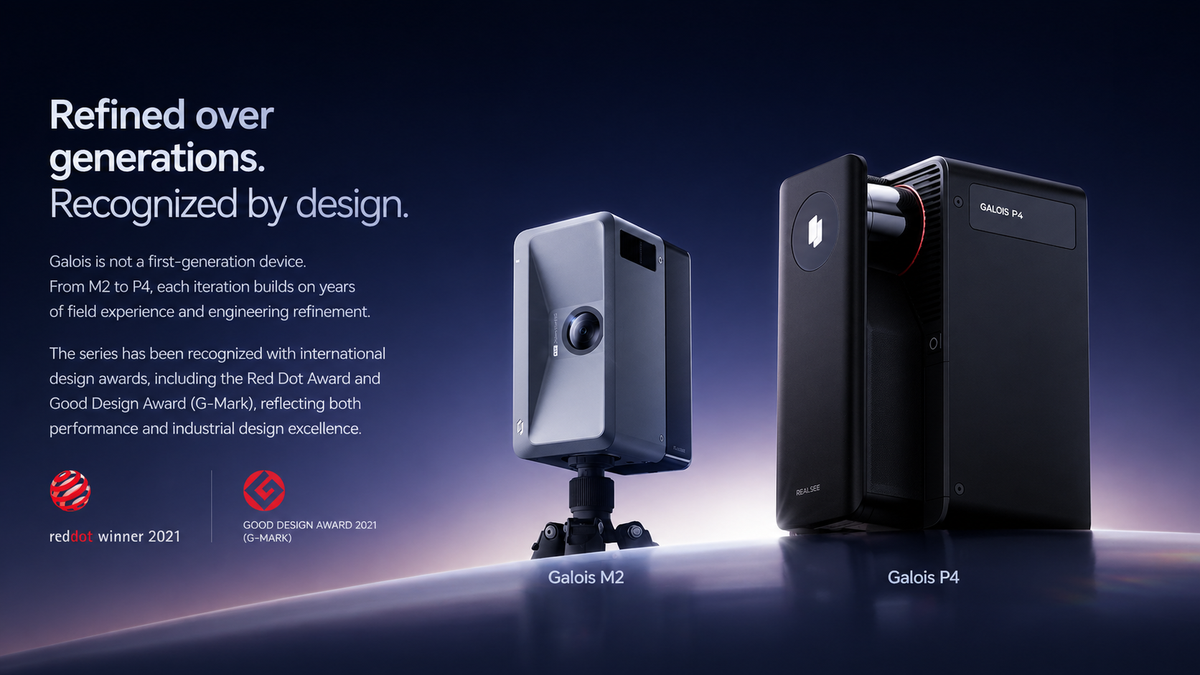
High-Resolution Imaging with 24K HDR and Galois P4
While LiDAR provides the geometric skeleton, high-resolution imaging supplies the visual richness that makes virtual tours genuinely useful for documentation and client communication. Cameras equipped with 24K HDR capability capture environments at resolutions far beyond standard photography, preserving fine details such as surface textures, material conditions, and signage that surveyors need for comprehensive reporting. High dynamic range processing ensures that both shadowed corners and brightly lit windows render with clarity, eliminating the blown-out highlights or crushed shadows that plague conventional captures in challenging lighting conditions.
The Realsee Galois P4 exemplifies this advanced imaging approach, combining ultra-high-resolution capture with integrated spatial awareness to produce imagery that aligns precisely with underlying measurement data. For surveyors, this alignment is critical—it means that any point visible in the virtual tour can be referenced back to an accurate spatial coordinate. The marriage of photographic fidelity and geometric accuracy transforms virtual tours from mere visual walkthroughs into interactive measurement environments where clients and collaborators can extract dimensional information directly from the imagery, reducing the need for return site visits and accelerating project timelines.
Enhancing Surveying Accuracy for Virtual Tour Creation
The accuracy improvements that 3D cameras bring to virtual tour creation stem from their ability to eliminate the gap between what is measured and what is displayed. In traditional workflows, surveyors collected measurements independently from visual documentation, then reconciled the two during post-processing—a stage where discrepancies and alignment errors frequently emerged. Modern 3D cameras capture both datasets simultaneously from identical vantage points, ensuring that geometric data and visual imagery share a unified spatial reference frame. This inherent alignment dramatically reduces registration errors that previously degraded accuracy when combining separate data sources.
Point cloud data integration into virtual tours represents perhaps the most significant advancement for surveying professionals. When a virtual tour is built upon a foundation of millions of precisely measured coordinates, every surface and object within that tour inherits spatial accuracy. Surveyors can extract measurements directly from the virtual environment—wall-to-wall distances, ceiling heights, window dimensions, and irregular angles—without returning to the field. This capability transforms the virtual tour from a presentation tool into a living measurement database that supports ongoing project needs long after the initial capture session concludes.
The practical benefits extend beyond measurement extraction. Reduced errors in spatial documentation mean fewer discrepancies between reported dimensions and actual conditions, which translates directly into lower risk for construction planning and renovation projects. Clients receive deliverables they can trust without independent verification, and surveyors spend less time addressing measurement disputes. Furthermore, the consistency of automated capture eliminates the variability introduced by different team members taking manual readings under varying conditions. A 3D camera produces repeatable, objective results regardless of who operates it, establishing a new baseline for quality assurance in surveying practice and enabling firms to scale their operations without sacrificing the precision their reputation depends upon.
Practical Implementation: Steps for Surveyors to Leverage 3D Cameras
Step 1: Selecting the Right 3D Camera Equipment
Choosing the appropriate 3D camera for virtual tours begins with evaluating the scanning environment and accuracy requirements. Surveyors working in large commercial spaces need equipment with robust 3D LiDAR scanner capabilities that can accurately capture distances across open floor plans. For detailed interior documentation, prioritize systems offering 24K HDR imaging alongside integrated spatial sensors, ensuring that both geometric precision and visual clarity meet professional standards. Consider the device’s point cloud density specifications—higher density translates to finer detail in complex environments with irregular surfaces or intricate architectural features.
Step 2: Data Capture and Processing with Point Cloud Technology
Effective data capture requires strategic scan placement to ensure complete coverage without gaps or shadow zones in the point cloud data. Position the camera at regular intervals throughout the space, maintaining clear sightlines between scan positions to facilitate accurate registration during processing. During post-capture processing, verify alignment quality between overlapping scans and inspect the merged point cloud for anomalies. Clean the dataset by removing noise points caused by reflective surfaces or moving objects, producing a refined spatial model that accurately represents the surveyed environment.
Step 3: Integrating into Virtual Tours and Reporting
With processed point cloud data in hand, surveyors can generate virtual tours that function as both client-facing presentations and measurement-ready documentation. Export the aligned imagery and spatial data into virtual tour platforms that preserve the geometric relationships captured during scanning. Embed measurement tools within the tour interface so that collaborators can extract dimensions on demand without specialized software. For professional reporting, generate floor plans, cross-sections, and area calculations directly from the same dataset, ensuring consistency across all deliverables and eliminating reconciliation errors between visual and dimensional documentation.
Transforming Surveying Through Precision 3D Capture and Visualization
The integration of 3D cameras for virtual tours has redefined what surveyors can achieve in terms of accuracy, efficiency, and deliverable quality. Technologies like the 3D LiDAR scanner generate dense point cloud data that captures environments with millimeter-level precision, while high-resolution imaging through 24K HDR and systems like the Realsee Galois P4 ensure that visual documentation matches the geometric rigor underneath. Together, these components eliminate the traditional disconnect between measurement and visualization, producing virtual tours that function as reliable spatial records rather than approximate representations. For surveyors, the practical impact is substantial—fewer site revisits, reduced measurement disputes, consistent results across projects, and deliverables that clients can trust for planning and decision-making without independent verification. As these technologies continue to mature, the boundary between surveying and immersive digital documentation will dissolve further, enabling professionals to capture increasingly complex environments with greater speed and confidence. Firms that embrace these tools now position themselves at the forefront of an industry where precision and visual communication are no longer competing priorities but complementary strengths delivered through a single workflow.


